Club Meadowvale

Club Meadowvale
Club Meadowvale

Monday, 18 August 2014

Go social with Club Meadowvale!

All work (out) and no play? It’s time you went social with Club Meadowvale.

Sure, Club Meadowvale is a fitness and racquet club in Mississauga and now Club Meadowvale has established existence on popular social media stands like Facebook and Twitter and would love to get linked with members and other fitness and racquet sports devotees. Please use the links shown above to connect with us.

While on the topic of social, here is a post by one of our members that may help you grow your profile and presence on Twitter.

Six tips for Twitter users who have less than 25 followers 

  • Increasing a Twitter following takes time: Twitter is all about engagement. The more engaged you are, the more you get noted. This can be in the practice of tweets, retweets or mentions. For a new comer, tweeting is the toughest part and often does not come logically. It often aids if you start by tweeting content that you come through in your day-to-day life. Most blogs and websites have a “Tweet this” button that will enable you get started.

  • Start with friends and associates: Look up your friends and peers to see who follows them. It is likely that if you follow them, they will follow you back. You have to start somewhere; so, no harm in a little self-promotion. If you are on LinkedIn, a number of your “connections” may have a Twitter profile as well and may be interested in following you. If you have a decent profile, you will be noticed. My first five followers collectively had less than 30 followers.

  • Look for high-profile Twitter users who are not opposed to following: Generally speaking, Twitter celebrities like to be followed than follow. However, there are exceptions. A quick look at a person’s followers to following ratio will give you an indication of a person’s propensity to follow back. Here are two high-profile Marketing celebrities, that I follow, that have completely different approaches to following. Though these statistics are dated, it goes to prove my point.

To read more Click Here.

Wednesday, 23 July 2014

Squash or Tennis, which is your sport??

You ask tennis players, and you will find that their belief in the superiority of their game over squash is unwavering. As the debate continues, I consolidated the previous versions of this discussion into a new post along with a few new ones that came to my mind. So here is a lighthearted look at  “squash vs. tennis” that may make you smile and think.

A squash player’s thoughts on tennis: Tennis players need two serves to get a rally going. Tennis players need three balls to play the game, squash players are more efficient. In tennis, you have to break your opponent to win, in squash you just have to beat them. Squash players don’t feel the need to convert every shot into a forehand shot. Tennis has deuce and ad courts; in squash it is just right and left.

If you play either squash or tennis, you know that both the games require speed, agility, endurance, power and strategy.  Most squash players have no doubt that their game is the hardest of all racquet sports, particularly when compared to tennis. My friend Bill Guest lets the image on his parking spot speak for itself! 

In Tennis, hitting the line is considered an excellent shot; in squash it will cost you.
In tennis, a passing shot is a winner, in squash it’s just good length.
Love does not count for a whole lot in tennis.
Tennis players need to rest after every two games; squash players have fine-tuned the art of callings “lets” and arguing with the referee. The reverse view: Tennis is a spectator sport; squash wants to be a spectator sport. Squash needs tennis players’ support to get into the Olympics (may be!) In squash, players try to let the ball die; in tennis players try to kill it. Squash players pretend that a “nick” is a repeatable shot. That is like calling this a repeatable shotTennis players warm up before the game; squash players warm the ball up.

 In Tennis, players don’t hide behind your back. Squash players need walls around them to keep the ball in the court. In squash, you can get a “stroke” and continue to play; in tennis if you get a stroke you need an ambulance! In squash a dead nick is a good shot, in tennis, dead Nick is, not good for Nick! Squash players struggle with their scoring system – 9, 11, 15, PAR… Squash pros make a living; tennis pros make the Forbes list. Tennis players only boast when they are off the court. Tennis has an injury named after the game – tennis elbow, squash does not. Squash is played with tins, boxes, and lines. It’s OK to cheat in squash, as long as it means poaching to one side of the court. In squash, “serve and volley” means that you serve and your opponent volleys. In squash, your opponent can push you from the back and flash the “L”oser sign, especially when you seem to have an advantage. In squash, the referee can often threaten you with a throat-slashing motion. In squash, if you make an “attempt” to play a ball the referee may give you another shot at it.

Would be sweet, in real life! In squash, grammar is less important – “no let”, “tight length”… Squash players seem to be standing around and looking back during rallies. So there you have it. If you feel that “never the twain shall meet!”, we should perhaps ask the badminton players to join in the conversation! If you think of other one-liners, please add them in the comments section below and share this with your friends. If you liked this post.

Click Here to read more from us

Tuesday, 24 June 2014

Grooming the next generation of squash and tennis players

Canadian tennis is on the upswing; what about squash?

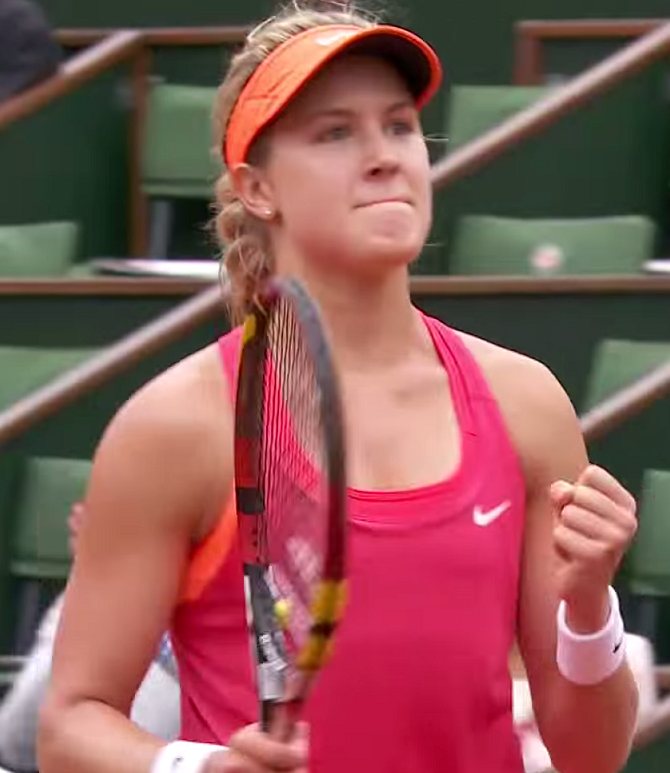
The highest world ranking ever achieved by a Canadian tennis player is No. 9. The highest world ranking achieved by a Canadian squash player is No. 1. Canadian tennis is on the upswing while Canadian squash has some work to do. Eugenie Bouchard - Canadian tennis
For the first time in Canadian tennis history, two Canadians reached the quarter-finals of a tennis grand slam tournament – the 2014 French Open. As Milos Raonic went down fighting against the second seeded Novak Djokovic and Eugenie Bouchard clawed her way past Spain’s Suarez Navarro to reach her second consecutive grand slam semi-final, an obvious question comes to mind – Can a Canadian win a tennis grand slam title?
It is possible. A Canadian tennis grand slam champion is no longer a pipe dream!
So what is happening in tennis that is not happening in Canadian squash?
Eugenie Bouchard currently ranked twelfth in the world and Milos Raonic, ranked ninth, have helped revive interest in Canadian tennis that has been missing for a while. Squash has no equivalent. The PSA rankings show Shawn Delierre, the highest ranked Canadian squash player, sitting at No. 74 while Samantha Cornett, ranked at No.30 on WSA’s list, is the highest ranked female squash player from Canada.
Not ideal!
Historically speaking, Daniel Nestor was the only one getting any limelight among Canadian tennis fans. Despite eighty-five career titles and $11 million in earnings, Nestor is not exactly what you would call a household name. But, now we have fresh blood; the game is back on track.
So what’s up with Canadian #squash? When will we see another Jonathan Power?
Clearly, it has to do with money.
The top ranked squash player in the world – Nick Matthew – earned just over $300,000 in 2013. The ninety second ranked tennis player Michael Russell made over $200,000 during the same period taking his career earnings to over $2 Million. Unfortunately, squash players trying to make a living playing the sport have to content with the fact that they may need a real job to support themselves past their competing days.
Melanie Jans, shown in the video below, is a perfect example! Melanie who was ranked as high as No.25 in the world, joined Club Meadowvale as the head squash pro in 2012 .

So, can the love of the game alone get Canadian squash back to its glory days?


To view original source Click Here

Thursday, 29 May 2014

A video survey: Should there be lets in squash?

Squash players can sometimes be irrational...!!!

This is especially true when it comes to let calls. What one player claims as a definite let, appear to others as a fishing exercise.  Clearly, the issue is not confined to club squash. Many argue that until the game rids itself of lame lets, it will never gain the kind of media coverage and popularity it deserves. As the championship matches at Club Meadowvale wound down, I decided to have some fun and did a quick video survey of random squash players who were milling around at the club. I asked everyone one simple question – Should there be lets in squash?
Here’s what they said.


As you can see, each player has a different take on why lets should or should not be allowed in squash. Some had logic behind their choice; others, less so. The result was fairly even with the “no let” camp edging out the “yes” camp by one. This came as a surprise since the club has never offered a no-let format for the players in the house league matches or their round robin games.
Unlike a fight in ice hockey, an argument on the squash court is not considered entertainment by the spectators and the media. Referees taking the brunt of player frustrations – justified or otherwise – have been the norm and continues be so. Alan Thatcher of Squash Mad has written about this in a post titled “Why it’s time to address our refereeing system”

Looking back at the survey, I tend to agree with Alan Glen. The no-let format should be left to professional squash players.
Perhaps I should have asked “
 To watch video Click Here

Wednesday, 23 April 2014

Feedback From Valued Customer


Here is some feedback we recently got from a member:

“Mark and I purchased 1 package of lessons for Naomi a month ago and wow our instructors and programs are utterly amazing. Here is my story

Seeing is believing

I can now say with even greater conviction that our swimming lesson program is exceptional. For over 9 years I have successfully lead our Red Cross Swim department. Just recently I had the pleasure of witnessing my 4 year old daughter advance in her swimming technique and water comfort all within 1 package of lessons. Naomi can now swim at length without water wings and it has truly astonished our family.  Club Meadowvale has the perfect platform to build swimming success: a private pool setting, complete instructor attentiveness, personalized programs, and unlimited practise time.”

Learn to swim with Club Meadowvale

Thursday, 20 March 2014

The Reason You Don’t Show Up At The Gym

As a long time club owner, I have had the chance to see members come and go with varying results and levels of dedication. Many members struggle to stick with it and end up paying for monthly memberships, which are never used or canceling. Here are some practical ideas, which we notice with our regulars, who get results!

They workout at the same time every day.

They pre-book this time, so it can’t be replaced by another personal or work meeting. It is in their calendar, so when they look for a meeting time, they see that time is already taken and do not book something else.

They don’t go crazy

Our consistent members don’t feel that they need to blow the doors off the place with really hard workouts. They just show up at a set time and do what they feel like doing. Sometimes they push hard sometimes they don’t. (EG-They just got a promotion at work, so they ride the positive wave and do an extra 20-minutes of cardio)
Inconsistent members tend to build up a really tough workout in their head prior to getting to the gym, which usually is followed by talking themselves out of even showing up.
Solution: Just book your time, change and be at the fitness gym.

Diet

Consistent members, change their diet. Workouts can be quickly and easily ruined with one bad food choice. A high calorie muffin per day or a specialty coffee with whipped cream and chocolate can set you back. This will end with you not seeing results and deciding not to continue.

You picked the wrong gym

There is plenty of thought that goes into the types of equipment or classes gyms have. There is also a consideration regarding location. The key element, which will stop you from showing up, is the type of people at your gym. Gyms used to be called health clubs or fitness centers, with the key word being “club”. Gyms are still clubs and these clubs attract certain demographics.
As an example, if you are middle-aged senior executive, you may not feel comfortable at a gym with young muscle bound kids, who are into power weight lifting. Their social interaction and behavior might be annoying or demotivating. (Even if you don’t socialize at the gym, the environment will be a turn off)
Try to find a gym or club, which suits your personality and social expectations.

To view original source Click Here

Thursday, 27 February 2014

Great Fitness Read For Boomers

Younger Next Year-By Chris Crowley and Dr. Harry Lodge The lead author of Younger Next Year is Chris Crowley who, at the time of publication, was a 70-yr old attorney in Manhattan.  This book is an outgrowth of his relationship with his personal physician, internist Henry Lodge, MD.  As a result, Crowley has become an evangelist for the health benefits of exercise. The book is based on Dr. Lodge's 7 principles, referred to as "Harry's Rules":
  1. Exercise 6 days a week for the rest of your life.
  2. Do serious aerobic exercise 4 days a week for the rest of your life.
  3. Do serious strength training, with weights, 2 days a week for the rest of your life.
  4. Spend less than you make.
To read more Click Here